Names: You have one, I have one, characters have one

Most writers will send hours pouring over names, searching for that perfect one that fits a character like a shoe. We can spend hours on this endeavor until we finally arrive at “The One.” There are many name website out there to help us on this task; I personally love www.behindthename.com, which is my go-to site for the numerous countries represented and the random name generator; it also has anagram names and name themes section.

With all these sites, it is easier than ever to find that perfect match; however, writers need to watch themselves and guard against certain naming pitfalls. What pitfalls you ask? Setting plays a big part in what names you can be used, believe it or not. If you are writing a Japanese historical fiction novel, you aren’t going to want to name your character Kelly or Susan — no, you will want to use names like Akane, Keiko or something else of that variety. This is a major pitfall in fanfiction and just screams lazy, do not read me, I’m a Mary Sue!

Of course, there are ways around the above. Your character’s parents might have been fascinated with that culture or spent time in it and decided to name their child one of the names that they had grown fond of from that culture. It happens all the time nowadays.

Another pitfall for historical fiction is poor research. Some names may not exist yet during the time period you are writing in, or perhaps the spelling variation you have fallen in love with was not used at all during that time period. So be sure to do you research before setting that name in stone. Finding popular name lists for the different years can be helpful on this subject like this one on BabyCenter.

Another consideration is: What are your societies norms for naming children? The best why to answer that questions is to look at different countries, and once again, Behind The Name can be handy since they have little sections about different countries’ names and naming practices. For instance, in France, parents have to look at a list of approved names; they are not allowed to name their children anything that is not on that list, so no Blue Ivy or Apple. Perhaps the culture your character resides in has similar rules that are aimed at preserving traditional names and/or protecting kids from future bullying.

Additionally, does the society your character resides in use middle names for their people? If yes, what is the usual number of middle names per person? Does it vary by class? Or perhaps your society does not use middle names. And how about surnames? Do your societies use them or not? There are some societies out there that don’t use, plus there were some periods of time where surnames were not used. Or perhaps, like the Japanese, your character’s society puts the surname before the given name of a person. If you are a speculative fiction writer, consider playing with some of these different aspects. If you are writing historical fiction or any other genre with a novel that takes place in another society or culture, make sure you follow that time period or societies’ guidelines for names.

Finally, be weary of choosing names with certain meanings or that describe your characters, unless you know who to do it properly with out rubbing them into your readers’ faces, making them groan. Bella Swan (beautiful swan) is a perfect example, largely because it only further highlights the self-insert nature of the character and it just shows blatant favoritism. However, meaningful names can be refreshing and fulfilling if they are more subtle or perhaps the opposite of your character’s personality.

Also don’t forget other forms of significance, including characters being given the names of other family members or people significant to the family or parents. A name that has been passed down from generations can be a nice touch; it also provides grounding and a history — a feel that your world has existed for some time or the family has.

Don’t be afraid to try new things or take some of the old naming cliches and playing with them; after all, the old-and-tired are not necessarily bad as long as they are given a new spin.

App Review: Astrid Tasks

original
Let me be your personal assistant! With a grin like this, how can you resist?

Sometimes a writer needs all the help they can get to stay focused, organized and on task. While not strictly a writer’s app, Astrid Tasks can do just that for a writer: allowing writers to organize writing tasks, prioritize writing tasks, set deadlines and share task lists.

The app, available on Android phones and tablets, iPhone, iPad, and on the web, is easy to use. I have experienced some minor glitches on my Android phone, including the app spontaneously shutting off or tasks not disappearing right away after I cross them off; however, these have only been minor annoyances, no where near being a deal breakers.

Astrid Tasks’ menus are clear and easily navigated. The default menu sections are: My Tasks (the main list), Today, Recently Modified, I’ve Assigned, Not in any List, Home, Personal, Shopping and Work. However, users have the ability to create their own lists, such as a writing list. Once you have your custom list, it is easy to add writing tasks, such as complete outline, finish query letter, etc., simply by hitting the plus symbol. Then as you add tasks you can assign priorities, deadlines and a description of the task.

Users also have the ability to share lists, which can come in handy if you are co-writing a writing project with someone else, so you both can see what needs done. There is also the ability to assign certain tasks to different users in a shared list. Users can also leave comments to let their co-author — this feature can also be used to leave yourself comments/notes.

Other handy features include the timer feature, which allows users to record how much time they have spent on a task, and reminders, which will send a message alerting to impending to deadlines. The reminder feature is customizable to go off when a task is due, when a task is overdue or to randomly remind a user of their task during a period of time they set.

All in all Astrid Tasks is a handy app for organization. It also encourages writers to sit down and prioritize what needs to be done and when. Astrid Task is definitely, plus the regular version is free, so you aren’t out anything but time. There is also an premium version of Astrid Task, which is not free, so be careful what you click!

Writing Prompt #5

Up to this point, the writing prompts I have posted have been geared toward improving a writer’s knowledge of their character(s); this time, however, I’m going to shake things up a bit and have the focus be on world-building.

And here is the prompt: You are a tour guide for your world and will be directing a group of people who do not exist in your world to five or 10 places in your world. Write down these five or 10 places and then explain why you would show them to your visitors. You must relay the following information: What are some of the sights you would show them in these places? What recreation is available in these places? What is there in these sites to quench the interests of different age groups? What foods or eateries would you highlight? What historic sites would you stop at and why?

Expand on the questions as you please: After all, the more you know ;).

World-building Series: Money, money, money

Money truly makes the world go around, so it is a given writers’ built worlds will have it and that the characters that inhabit the world will have to use it at some point: whether to get provisions or procure lodging. Money, or currency, has seen interesting transformations in our world, evolving several times before becoming what we know today.

Why is it important to include currency on your world-building to-do list, you ask? Your reader is reading your novel, fully immersed in the world you have built, and then suddenly your characters go to buy a loaf of bread: They are paying with a dollar. The fantasy is shattered. The currency is American and sticks out like a sore thumb. So what options are available to speculative fiction writers?

Bartering was the main way of exchanging goods for the longest of times, and who knows, maybe some of your worlds use this tried and true system for exchanging goods that is still around today. If they are, you will need to figure out an approximation of equivalent exchange: what can a character get for a cow, for instance? Are cows considered valuable in your world or are they not as valuable, as say, a llama. These are the questions you have to ask yourself when creating a bartering system that your characters will no doubt be using. Another hot button topic with a barter system that writers have to ask is: What is the barter system for services? What do characters have to give in order to stay at an inn?

Is the bartering system not fitting in your world? Perhaps it is time to introduce more concrete forms currency. Don’t fall into the trap of thinking all money has to be metal and paper. Did you know that cowrie shells were once considered a form of currency? In fact, cowrie shells are the most widely and longest used currency in the world. Other unique forms of currency include leather money, wampum (beads made from clam shells), among others. Look at your worlds and see if there is anything unique that might be used as currency.

If your heart is set on coinage and paper money, go for it. Coinage has been around for a long time with the NOVA website stating it has been around since 1000 B.C., originating in China, while paper money first appeared in 806 A.D., also in China. I will admit, coinage and paper money is very fun, at least for me. I have enjoyed determining what goes into the making of the different coins used by one of my countries, including the metals used and each ones’ appearance as far as markings. There is nothing more fun than designing your own coinage or paper money. However, coinage comes with its own set off questions writers need to answer: who mints it and where? Or are there multiple versions of coins that crop up in different regions? Similarly, who is in-charge of creating the paper money?

If you are writing a futuristic tale, currency may have further evolved further to becoming completely electronic, a path that we are currently on the way to, or at least it would seem. However, the sky is the limit when it comes to creating currency types.

Alright, you have a pretty good idea about what type of currency you want, now where are your characters going to store their currency safely? Does your world have banks? If yes, who runs them? Are they government-owned or family-operated? Banks, in the modern sense of the word, appeared in medieval  and Renaissance Italy, and were operated by wealthy families, such as the Medici family. Going along with banking, were there certain sects within your world or countries that were more prone to be apart of banking, such as the court Jews, who would loan money to European nobles or serve as financial advisers to them?

Some other consideration for writers to ponder as they world-build currency: How do your countries combat counterfeit currency? Who is backing the money since certain types of currency require a strong government to back them? How do the different currencies translate between countries? Do your countries have a problem with different regions or cities within them minting their own currencies? Do certain currencies have nicknames, such as greenbacks, bucks, pink lady, etc.?

While currency might not seem like a very big thing to worry about when world-building, and writers probably shouldn’t put too much time into its creation, writers will find that putting a little time into creating currency for their world will only enrich the reading experience of their readers.

Setting: Hobos in Outer Space

I cannot remember where I heard this phrase — I imagine it was while I was at Purdue — but whenever I think of setting, it springs to mind. Sometimes characters just seem to float in a void, especially in works belonging to fledgling writers. There is nothing around, or at least, the reader is not given any hints that there is anything more than a blank white room: hence the term, hobos in outer space or characters floating around in an environment that is absent. While the phrase is not necessarily accurate, there is actually a lot of things in outer space, it does bring humor and thought to writing settings.

Settings surround your character no matter where they go, or they should. Settings can bring realism, in addition to relaying information about the culture your characters resides in or information about your character — especially if a scene occurs in their bedroom. Setting can also set the mood or provide foreshadowing, such as with the famous Snoopy literary ace starting line: “It was a dark and stormy night…” The presence of certain objects in settings provide a sense of foreboding to the reader, though writers need to spice things up and not rely on the cliches, like a dark, stormy night. And don’t forget plot relative items in settings, they should be prominent in setting prior to plot use.

Setting details can be relayed in many different ways from exposition to characters interacting with it, the latter being one of the better ways introduce setting details. Use all five senses to relay setting details through your point of view character, have then really interact with their environment within reason — characters do not need to be licking everything unless that is in character.

However, like with all things writing, writers need to avoid info dropping; there should be no whole paragraph after paragraph relaying setting information since that will only make the reader skip over sections or yawn. However, writers should consider writing out details outside of their manuscript, especially if a certain setting is used repeatedly, to prevent inaccuracies from occurring when you return to that particular setting. Not all the details you record in a separate notebook or document will make it into a manuscript, nor should they, unless you simply wrote a sentence or two.

Historical fiction writers have a particularly rough spot with settings:Not only do they have to use settings, they also have to put hours into research to make sure they are historically accurate — it is a tedious process, but rewarding, especially if you have reader compliment your attention to the details. Speculative fiction writers also have to be aware of those details, which harkens back to the age old: Know your world inside and out. In addition, speculative fiction writers also have to relay information on settings that might be completely foreign to earthly readers, which can have its own challenges, particularly with the overburdening desire to info dump.

Some final advice, look at your favorite books/authors to see how they handled settings, dissect them to see what worked or what could have been improved. Seek out books that you have heard are good from friends or fellow writers and dissect those as well.

More Information Of Setting

Also visit my friend’s blog, she gives several great ideas for improving settings in your stories. Also be sure to check out some of her other articles, she is running a whole “Why Good Writing Matters” series with some great tips.

Character Series: Education

What was your characters’ education like? It is an aspect of your characters that you should know since education will be a deciding factor on what jobs your characters can have, their world views and how easily they can navigate through life.

Ask yourself what type of students your characters were. Did they engage in their education or shrink in their desk hoping the teacher would not call on them. Or perhaps they had a nontraditional learning experience, being home-schooled or born in a period of time when public schools, as we know them, did not exist. If they are from a different time period or world, it might be that rather than schooling, the young focus more on learning trades — some might never learn to read or write.

Other questions to ask when it comes to education include: What were your characters favorite subjects, their least favorite? Did they have any learning disabilities that made their education difficult? Was there a teacher that particularly impacted their life, that really helped shape who they are? Did external factors, like their home life, affect their education or lack of education? Did they leave early without completing their education? Was there a time they were a good student? How long did they study a skill or trade? What were the different levels of education they’ve completed?

Once you know a character’s level of education, you can begin to ascertain career or job paths that are open to them. You will know if they can become the police officer you envision them as or the teacher you want them to be. Or writers can research professionals or period trades to determine what education would be required to fit the job: Think how this tailored education might have affected your character’s life. If their education was very time consuming, they may not have had much time for friends or special activities. In period pieces, your character may even be required to leave family to pursue a particular trade.

Similarly, you will know that a character’s lack of formal training or education will place limitations on what they can do. Take time to reflect on all the challenges that will face a character who has no or very little education, especially if said character never learned to read or write.

Finally, consider educational bonuses or advantages your characters have received. Do you have a character that is multilingual? Have they specialized in certain fields or trades? Such little things might come in handy at some point during your story.

Writing Prompt #4

[Writer’s Note: Another late night at work, this time doing a chicken photo-shoot — yes, you heard me correctly. Tomorrow there will be another character series post, and I will get caught up on responding to all the comments, at least by Saturday.]

Your character finds a genie lamp and can make three wishes. Write a short story detailing what they wish for and if their wishes come with a price. Follow the same rules from Disney’s Aladdin: no bringing people back from the dead, no making someone fall in love with someone and no wishing for more wishes.

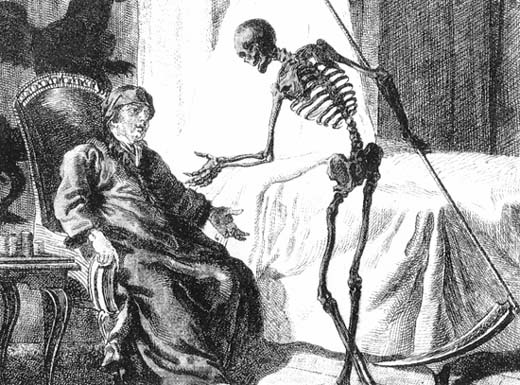
Killing your darling characters

Mort
“Because I could not stop for Death, He kindly stopped for me […]” — Emily Dickinson
There are many darlings writers kill: words, scenes, characters or even complete story lines and books. Rather than look at the whole, I am going to focus on characters — they are often the hardest to visit death upon, whether by killing them in a novel or completely removing them from a manuscript. Let’s face it, characters have a tendency to worm their way under our skin — we watch them grow, we know them.

I had always planned to write a general on this subject that focused not only on characters, but I decided to narrow it down after watching the major backlash against season three of Downton Abbey (no, spoilers beyond the fact it involved character death). Comments grew quite heated on online discussion boards, viewers shaken to their core: They were furious with the writer, though he really had little choice given the time period the show occurs in and uncooperative actor(s). I was not so shocked or disappointed, life happens and often it is not pleasant — we have our highs and we have our crushing lows.

However, one commenter on the LA Times discussion board got me thinking, after commenting: “To raise viewers up so high and then suckerpunch them right before the credits roll was incredibly manipulative. It pulled me right out of the fantasy and I’m not going to bother with season four.”

‘It pulled me right out of the fantasy,’ this part in particular lingers with me. It is true there are readers/viewers out there who only read/watch for escapism, though personally I read to be challenged or to be touched: I love it when a book is capable of making me cry. But, it does make one question before eliminating key or beloved characters, especially when you think of potential backlash and causing readers to rage quit; this in return leads to doubt, which leads to the dark side — umm, no, I mean — the loss of productivity. Writers cannot afford to constantly second guess themselves as nothing will get done. While you have to consider your audience, you must also consider your story and its needs.

Don’t fear having bad things happen to your characters, because more often than not, I feel writers have more of a tendency to coddle their characters, allowing no harm to come to them — at least, their favorites. Stephenie Meyer is particularly guilty of this with the worst thing ever happening to Bella being the birthing scene: But don’t worry, that is all wiped away in a matter of moments and then she is even more perfect than before.

Characters are writers’ babies, it is true: We create them, develop them from 2-D to 3-D. But, if we are to be good “parents,” we have to let them go into the world. Bad things will happen, but through them the character will grow. Our hardships shape us and make us who we are. Sometimes, this happens through death, sometimes our own or sometimes through the deaths of others around us.

file7161250705802
I was fine, then I was pushing up daisies!

Character death can be powerful: A character throwing themselves on a grenade to save others, a terminally ill character using their last days to make a difference, or a character using their last moments to get an important message out. However, in reality, death can be very random, often without the purpose or grandness that fiction often paints. Death can be long and painful or occur in an instance. Often times, people are left without closure with their loved one’s death.

Some readers appreciate this realism in fiction, others don’t as it breaks the ‘fantasy.’ The Downton Abbey reaction really got me thinking about my own writings, especially since in one project, I have several main characters die in the span of one book. Will I hit my readers’ breaking point? After all, I have raged quit books for seeming to purposely push by that line for the shock value. I think that is a fine line writers tread with their readers, and I think it is largely settled by writers not considering character death as shock value: Character deaths need to feel well thought out and progress the plot naturally — they should never feel like the writer is trying to manipulate their audience, that is trying too hard.

Character deaths also need to be acknowledged and given respect. Through other characters’ grief, readers are also allowed to process everything that has happened, especially if it was a favorite character. Nothing makes a reader balk like a character death only receiving a sentence of reaction, if that, and then nothing more. The aftermath does not need to be drawn out or melodramatic, but it needs to be real. Deceased characters should be remembered by the living characters, especially if they were important to them.

In light of the season three finale, I have found this interview with Downton Executive Gareth Neame (DO NOT READ UNLESS YOU WANT SPOILED) to be enlightening, especially when he talks about the story’s mythology. Every story has a mythology of things that have occurred in the writer’s head and are cemented there, because to the writer, they have already happened. This has read especially true for me since I started in a book later in the chronologically and then decided instead to write the prequels first, making them the foothold series. So I already knew the deaths, they are cemented, already a part of the mythology — the history — of the world, though the reader does not know it.

Know your mythology, don’t shy away from it out of fear of reader reactions; however, do not wield your scythe of character death like a raving lunatic. Cut threads with discretion, and don’t use character deaths for shock value — I’m looking at you “X-Men: Last Stand.” Writers also need to realize they can’t coddle their characters: They will never grow that way.

Writing Prompt #3

(Writer’s Note: Today’s post has to be a writing prompt, I had to take on two town meetings for a co-worker so have no time to prepare a writing article, but I have a really good one in mind that will hopefully be posted tomorrow.)

Through some misfortune, your character (or a group of characters) becomes stranded/lost in a dense forest, the nearest sign of civilization is hundreds of miles away, and to top things off, they have very few resources and only enough provisions for two days — four if they ration carefully. Write a short story that relays how they came into their predicament and how they proceed to survive and find their way.

With this scenario, I challenge writers to be honest about their character’s survival skills; let’s be honest not everyone has them. For many authors, it is hard to harm their “babies,” but sometimes you just have to push your babies out of the nest (P.S. Please, do not push real, living babies out of nests — that is just wrong). This little story can end pretty badly, but hopefully, in the process you will learn more about your characters particularly how they cope with stress or being in what could very possibly be hopeless situation.

May the muse be with you. Also bonus points for adding a bear to the story. Why? I just like bears.

file000693160182
Which way is north again?

Ten Days To Go!

Small Teapot
Where did all my clean tea cups go? Oh wait, I’ve used them all…

Wow, it is hard to believe after this post, I only have 10 more days to go until February concludes and then I can enjoy a brief period of crashing and focus more on my writing/read-through.

When I started my own blog-no-wrimo, I severely underestimated how time consuming it would be, especially since with each post I try to make them as informative as possible.

Even so, this experience has been a learning experience, and I’ve still been able to make progress with my read-through, though still not quite as much as I had envisioned — but once again, I severely miscalculated. However, there is still NaNoEdMo to catch up and then begin the querying process. I am also looking forward to possibly changing gears and switching back over to my Sci-Fi novel in April.

First, must get through February! So here’s to 10 more days of blog posting and hopefully some helpful writing articles, tips and prompts.